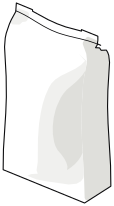
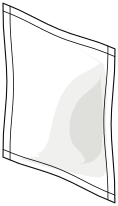
Stand-up pouch
A flexible pouch with three heat-sealed edges and an arched bottom gusset that opens out so the bag stands upright on the shelf.
Stand-up pouches (Doypacks) are the everyday retail pouch for coffee, snacks, granola, pet treats, powders and refills — like our Saltwick Sea Salt Kettle Chips example. The flat artwork layout places the front and back panels side by side, with heat-seal borders, the bottom gusset weld zone and optional zipper band marked as keep-clear areas.
Depending on your product, the engine adds a press-to-close zipper, tear notches above the zipper, a round or Euro hang hole, a punched top handle, a top or angled-corner spout for liquids, or a clear front window where white ink is knocked out.
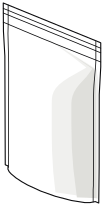
Parametric template. Drawn by the engine at your size. Seal widths, overlaps and clearances are initial values — confirm with your converter and order a proof before the first production run.
How it seals
- Sides and top: heat-sealed edges (provisional 5–7 mm default by width), top sealed after filling.
- Bottom: folded W-shaped bottom gusset welded along the arched bottom seal line.
- Reclosure: optional press-to-close zipper below the tear notch, or a top/corner spout instead of a zipper.
Good for
- Snacks, coffee, tea, dry powders, pet food and cosmetics refills.
- Liquid or gel pouches when configured with a top or angled-corner spout.
- High shelf billboard area with far less shipping volume than rigid jars.
Watch for
- Keep critical copy, barcodes and logos out of the edge seals, zipper band and arched bottom gusset.
- Clear windows need a white-ink knockout layer on transparent film; confirm ink sequence with your converter.
- Seal width, gusset depth and zipper offsets are initial values — confirm machine specs and order a proof.
What you can change
Parametric dieline built by the open-source engine at any size. Configure options with your agent or the pacxio CLI.
Dielines (DXF, CF2, PDF, SVG) and 3D previews are open source and run locally. Artwork layout, vector restoration, finish plates and factory packs run in the cloud — free during early access.
Leave auto to derive from pouch width, or set a custom gusset depth in mm.
Adjust heat-seal border width and optional rounded corners on all four corners.
Toggle press-to-close zipper and choose tear notch style (position mark, V-notch or slit).
Add a round or Euro pegboard hang hole, or a punched carry handle on large bags.
Configure a top-centre or angled top-right spout with custom spout diameter.
Mark a rectangular or oval clear window inside the front content zone.
Ask your agent
Paste this into Claude Code, Codex, Antigravity or WorkBuddy with pacxio installed.
Make a stand-up pouch 140 × 210 mm with zipper and tear notchQuestions
How are stand-up pouch dimensions measured?
Enter the laid-flat pouch width (L) and height (W) in millimetres, including the edge seals. Bottom gusset depth (H) is optional: leave it at 0 to derive an initial gusset from width.
Does the dieline mark where not to put text?
Yes. Edge seals, the arched bottom gusset, zipper band, tear notches, hang holes and spout zones are recorded as keep-clear zones and checked during preflight.
Stand-up pouch or flat-bottom pouch: which should I pick?
Stand-up pouches cost less to make and cover most snacks and lightweight refills. Pick a flat-bottom pouch when you want five crisp printable faces (including side gussets and a flat base) for heavier or premium coffee, tea and pet food.