Flexible pouches: Stand-Up vs Flat-Bottom vs Pillow vs Sachet
Flexible film pouches ship flat, weigh a fraction of rigid jars and protect coffee, snacks, powders and pet treats with multi-layer barrier laminates. Choosing the right seal layout determines how the bag stands, fills and prints.
Unlike paperboard boxes, film pouches aren't mechanically creased with steel rules — their dielines define heat-seal bands, gusset folds, zipper clearances and (for form-fill-seal machines) roll-stock registration eye marks.
Four flexible pouch styles compared
Pick by fill volume, shelf presence and whether your co-packer fills pre-made bags or runs vertical/horizontal form-fill-seal roll stock.
| Pouch style | Structure & shelf presence | Best for & key options |
|---|---|---|
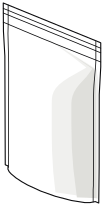
| Stand-Up Pouch / Doypack (pouch_standup) | W-folded bottom gusset expands when filled so the bag stands upright on retail shelves | Snacks, granola, tea, supplements, pet treats, liquid refills. Supports press-to-close zipper, tear notch, Euro hang hole, carry handle, spout and clear window. |
| Flat-Bottom / Box Pouch (pouch_flat_bottom) | 5 printable flat faces (front, back, two side gussets, flat rectangular base) — stands square like a box | Specialty coffee beans (250 g–1 kg), premium pet food, heavy powders. Supports pocket/front zipper, tear notch and one-way coffee degassing valve. |
| Pillow / Back-Seal & Quad-Seal (pouch_backseal) | Single wrap-around sheet meeting at a centre back fin seal (or corner seam with side gussets for quad-seal) | Chips, noodles, frozen foods, coffee bricks, high-speed VFFS roll stock. Add side gussets (H > 0) and corner seam to leave the back panel uninterrupted. |
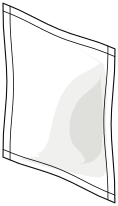
| Three-Side Seal Sachet (sachet_3side) | Two flat faces sealed around 3 sides (4th closed by factory or open for filling); lies completely flat | Single-serve skincare masks, sample sticks, spices, sauces, wipes. Supports tear notch, hang hole, roll-stock eye marks and custom die-cut contours. |
Engineering note. Structural allowances, seal widths and clearances in pacxio are initial values unless calibrated against a specific supplier's dieline. Confirm board caliper and tolerances with your converter and order a physical proof before the first production run.
Artwork rules converters check on every pouch
- Keep text and logos out of heat-seal bands: top, side and bottom seals typically run 6–12 mm wide and get compressed under heat jaws. Text placed on a seal warps and becomes unreadable.
- Account for zipper and tear-notch height: a press-to-close zipper sits below the tear notch and steals 25–40 mm from the top of the printable front face. Plan your title below the zipper band.
- White ink layer on foil or clear windows: printing CMYK directly on clear or metallized film looks washed out unless you supply a dedicated white-ink backing plate (knocked out where you want a clear window or metallic shine).
- Pre-made pouch vs roll stock: ask your co-packer first. Roll stock needs an exact repeat pitch, unwind direction and high-contrast registration eye mark (typically on a clear track) for the machine's optical sensor.
How pacxio builds pouch dielines
- Every pouch style in pacxio (pouch_standup, pouch_flat_bottom, pouch_backseal, sachet_3side) generates parametric 2D dielines and 3D previews locally in the open-source engine — including zipper bands, valves, gusset folds and eye marks.
- Seal widths, gusset depths and valve positions start from engineering initial values; confirm exact jaw widths and machine unwind specs with your pouch converter and order a proof before the first production run.
Try it with your agent
Paste this into Claude Code, Codex, Antigravity or WorkBuddy with pacxio installed.
Dielines and 3D previews are open source (MIT) and run locally. Artwork layout, vector restoration, finish plates and factory delivery packs run in the cloud — free during early access.
Make a stand-up pouch (pouch_standup) 160 × 230 mm with 80 mm bottom gusset, zipper and tear notch for 250 g roasted coffeeQuestions
Stand-up pouch vs flat-bottom pouch: which is better for coffee?
For 250 g–1 kg specialty coffee, flat-bottom (8-side seal) pouches stand squarer on shelves, offer two extra side panels for origin notes and roast dates, and hold heavier fills cleanly. Stand-up pouches usually cost less per unit for smaller runs or 100–250 g bags.
Why does a pillow pouch split the back panel in two on the dieline?
A pillow pouch prints on one continuous sheet of film that wraps around the product and meets at the centre back fin seal. Keeping artwork aligned across the left and right edges ensures continuous graphics after sealing.
Can I design flexible pouches in the online box generator?
The browser generator currently focuses on FEFCO and ECMA box styles. Flexible pouches and bottle/cup labels run through the open-source pacxio CLI and MCP plugin inside Claude Code, Codex, Antigravity or WorkBuddy.
What does a degassing valve need on the dieline?
Mark the valve's exact centre coordinates and a keep-clear zone around it on the non-printing technical layer so key typography and logos never collide with the punched hole.
Related structures


More guides
Most factory rejections aren't about taste — they come from preventable technical issues: RGB colours, missing bleed, dielines left on CMYK black, un-outlined fonts or missing white-ink plates.
Workflow · AI to printFrom AI packaging concept to print-ready vector filesImage models are great at exploring packaging directions in minutes — and terrible at producing files a printing press can run. Bridging that gap requires rebuilding the approved concept as clean, editable vectors on a real dieline.
Selection · FEFCO vs ECMAFEFCO vs ECMA box stylesTwo industry code systems cover almost every folded paper box you see in retail and e-commerce. FEFCO is for corrugated board; ECMA is for solid folding carton paperboard.